Important Financial Metrics
for designing your portfolio, developing strategies and understanding the behaviour
- beta
- alpha
- standard deviation
- sharpe ratio
- correlation
Systematic Risk & Unsystematic Risk
| Risk type | Source and examples | Also known as |
|---|---|---|
| Systematic risk | From events that cannot be planned: • Financial crisis (Lehman Brothers, 2008) • Global pandemics (COVID-19) • Wars (US–Iran, 2026) • Undiversifiable risk | Market Macro |
| Unsystematic risk | From individual companies or sectors: • New technologies • Changes in oil prices • Diversifiable risk | Individual Idiosyncratic Specific Micro |
Sharpe Ratio
- risk adjusted performance
- most widely used
- if then SR = Returns / SD
Beta
- measure of systematic risk or volatility against a benchmark
- design portfolio as per risk tolerance
- drawbacks - historical returns
- weighted beta of portfolio matters
covariance - relation between movement of 2 assets
Overall Beta
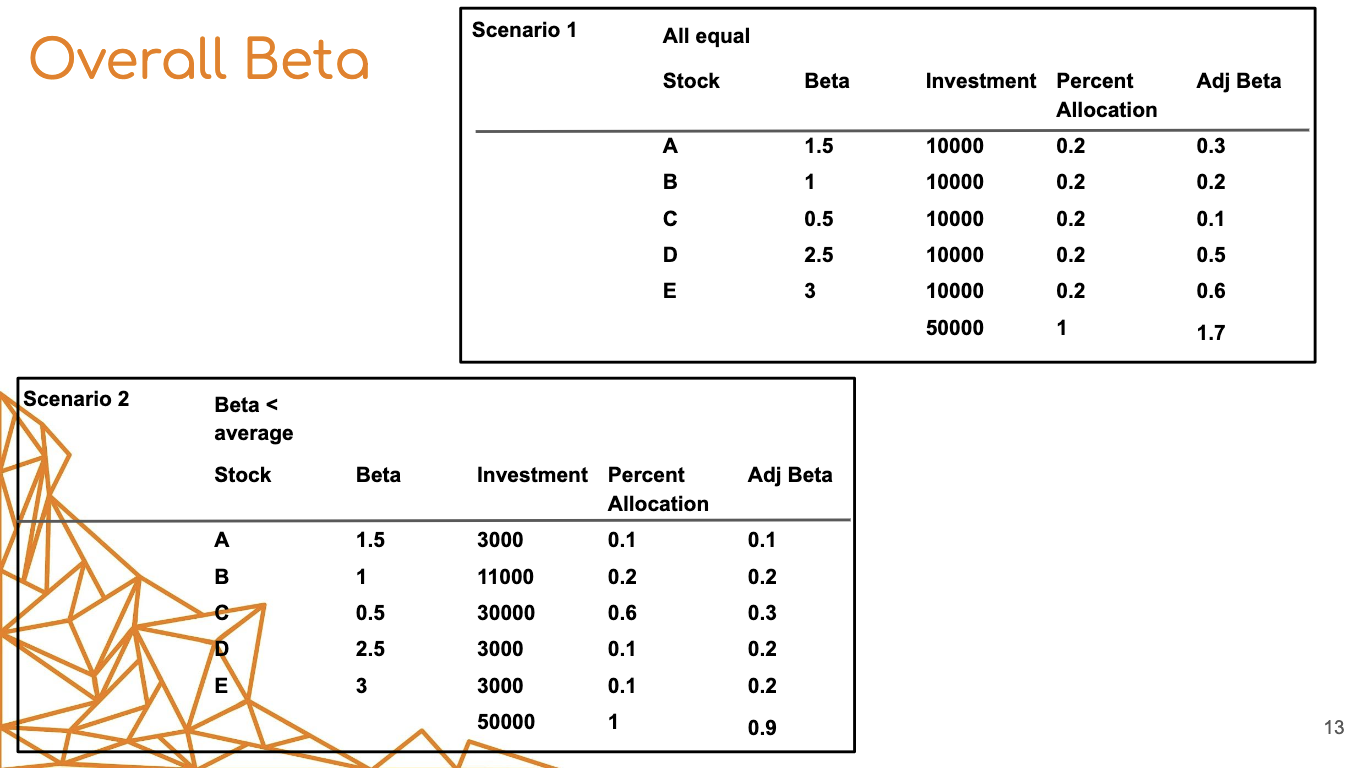
- A portfolio’s overall beta is the weighted average of its assets’ betas, where is each asset’s portfolio allocation.
- Allocating more to high-beta assets raises systematic risk; allocating more to low-beta assets reduces it. A market beta of is the benchmark.
Alpha
- from CAPM (Capital Asset Pricing Model)
- portfolio manager’s capability
- performance above the benchmark
- used in conjunction with Beta
expected return = risk-free return + compensation for market risk
Correlation
- the degree with which one instrument moves in relation to another
- ranges from -1 to +1 (standardised)
- tells the relation but not the causation