- diameter of a graph: greatest shortest path distance between any pair of vertices
APSP extends L15-16 SSSP to all pairs. Floyd-Warshall uses adjacency matrix → L12 Graphs. For DAG special case, uses topological sort → L13 Graph Traversal.
Floyd-Warshall
Key Idea
- Uses 2D Matrix for SP cost: D[V][V]
- initialisation: D[i][i] = 0, D[i][j] = weight of edge(i,j), if there is edge i → j, otherwise INF
- 3 nested loops
- after algo stops, D[i][j] contains the SP cost from i → j
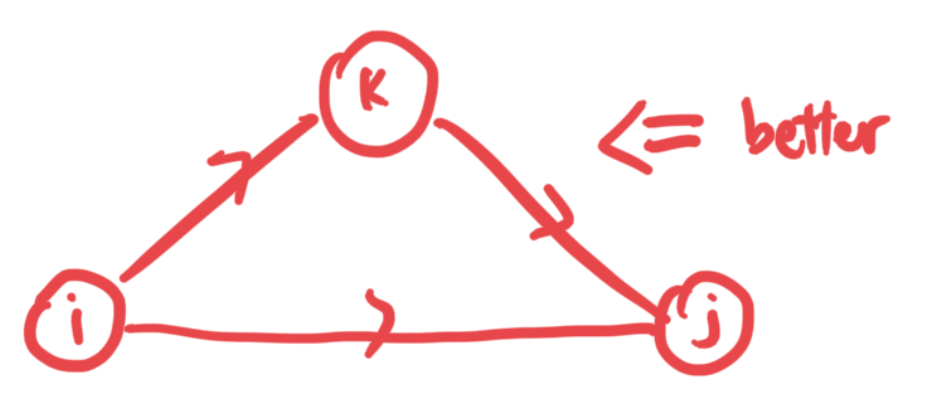
for (int k = 0; k < V; k++) // remember, k first
	for (int i = 0; i < V; i++) // i first
		for (int j = 0; j < V; j++) // then j
			D[i][j] = Math.min(D[i][j], D[i][k] + D[k][j])
// relaxation of D[i][j]- preprocessing (once): O(V^3)
- answering query: O(1)
- can only solve APSP for small graphs
- if E = O(V^2) and time is short
- uses adjacency matrix representation → L12 Graphs
- for sparse graphs, run Dijkstra’s V times instead → L15-16 SSSP
Assume that the vertices are labelled as [0 … V – 1]
- Now let sp(i, j, k) denotes the shortest path between vertex i and vertex j with
the restriction that the vertices on the shortest path (excluding i and j) can
only consist of vertices from [0 … k] - eg. sp(1,10,3) → sp from vertex 1 → 10 using only vertices (1,2,3)
- initially k = -1, then iteratively k++ until k = V-1
Applications (FW Variants)
| Print Actual SP | - use 2D predecessor array p - p[i][j] is the predecessor of j on a shortest path from i to j Key Idea: - initially, p[i][j] = i for all pairs of i and j (regardless of if edge(i,j) exists) - in the loop: → |
|---|---|
| Transitive Closure | - determine if i is connected to j either directly or indirectly - modify matrix D to only contain 0 & 1 |
| Minimax / Maximin | minimax: min ST maximin: max ST - finding the path that minimises / maximises the max / min edge from vertex i to j Key idea: (minimax) - for a single path from i to j, pick the max edge weight along this path - then for all possible paths i → j, pick the max edge weight that is the smallest - D[i][j] wil store the smallest max-edge-weight |
| Detecting positive / negative Cycle | 1. set the main diagonal of D to INF 2. run Floyd Warshall’s 3. Recheck the main diagonal - 0 ≤ x < inf = positive cycle - x < 0 = negative cycle |
Special Case: DAG Graph → L13 Graph Traversal (topological sort) + L15-16 SSSP (one-pass Bellman-Ford)
- When the graph is a DAG, simply call one-pass bellman ford for all the vertices according to its topological
order. - Toposort is O(V+E), calling one-pass Bellman Ford’s one time is O(E) time, so calling it for V number
of times (because we call it for all vertices in the topological order is O(VE) time. - Thus, the overall time
complexity is O(VE + V + E), which in general is faster than Floyd Warshall’s O(V3) time.
// print actual SP, in the loop:
if D[i][k] + D[k][j] < D[i][j]
    D[i][j] = D[i][k] + D[k][j] // relax
    **p[i][j] = p[k][j]** // update predecessor
// transitive closure, modified FW
// initially: D[i][j] = 0
// D[i][j] = 1 if edge(i,j) exists; 0 otherwise
// the 3 nested loops as per normal
D[i][j] = D[i][j] | (D[i][k] & D[k][j]);
// direct indirect// minimax / maximin
// same 3 comments as above
D[i][j] = Math.min(D[i][j],
Math.max(D[i][k], D[k][j]));