Summary
- DFS: by using a stack / recursion → see L6 Stacks & Queues
- BFS: by using a queue → see L6 Stacks & Queues
- both algorithms run in O(V+E) if graph stored in an adj list → see L12 Graphs
- both algorithms run in O(V^2) if graph is stored as an adj matrix → see L12 Graphs
Breadth First Search (BFS)
- Ripple-like manner
- Queue Q // visited[] (0 initially, 1 when visited) // p[v] parent array to memorise path
- Time Complexity: O(V + E)
// initialisation phase - **O(V)**
for all v in V
	visited[v] = 0
	p[v] = -1
Q = {S} // start from S
visited[s] = 1

// main loop - **O(E)**
while Q is not empty
	u = Q.dequeue()
	for all v adjacent to u // order of neighbour
		if visited[v] = 0     // influences BFS
			visited[v] = 1      // visitation sequence
			p[v] = u
Q.enqueue(v)- initialisation is O(V)
- for the while loop:
- Case 1: disconnected graph E = 0, takes O(E)
- Case 2: connected graph
- each vertex is in the queue once (visited will be flagged to avoid cycle)
- when a vertex is dequeued, all its neighbours are scanned (for loop); when queue is empty, all E edges are examined ~ O(E) → if we use Adj List!
// Reachability test
BFS(u) // or DFSrec(u)
if viisted[v] == 1
	Output "yes"
else Output "no"

// identifying / counting components
CC = 0 // component count
for all v in V
	visited[v] = 0 // initialisation
for all v in V // O(V)
	if visited[v] == 0
		CC++
		DFSrec(v) // O(V+E)
// BFS from v is also OK
Kahn’s Algorithm
// initialisation - **O(V+E)**
for all v in V
	indef[v] = 0
	p[v] = -1
for each edge (u,v) // get indegree of vertices
	indef[v] = indeg[v] + 1
for all v' where indeg[v'] = 0
	Q = {v'} // enqueue V

// main loop - **O(V+E)**
while Q is not empty
	u = Q.dequeue()
	append u to back of toposort
	for all v adjacent to u // order of neighbour
		indeg[v] = indeg[v] - 1
		if indeg[v] = 0 // add to queue
			p[v] = u
			Q.enqueue(v)
output toposort as the topological order
Counting SCC
// taken from bots THA
// second pass DFS on the transposed graph to identify SCCs
visited = new boolean[N]; // reset visited for second           DFS pass
int sccCount = 0;
while (!stack.isEmpty()) {
    int node = stack.pop();
    if (!visited[node]) {
        ArrayList<Integer> scc = new ArrayList<>();
        dfsRev(node, scc, sccCount);
        botnets.add(scc);
        sccCount++;
    }
}

// from lec notes
SCC = 0
for all v in V
	visited[v] = 0
for all v in K from last to first vertex
	if visited[v] == 0
		SCC += 1
		DFSrec(v)
Idea: If a vertex v is reachable from s, then all neighbours of v will also be reachable from s (recursive definition)
Depth First Search (DFS)
- maze-like manner
- Stack S // visited[] // p[v]
- Time Complexity: O(V + E)
// initialisation phase, in the main method
for all v in V
	visited[v] = 0
	p[v] = -1
DFSrec(s) // start the recursive call from s

DFSrec(u)
	visited[u] = 1 // to avoid cycle
	for all v adjacent to u // order of neighbour
		if visited[v] = 0 // influences DFS
			p[v] = u // visitation sequence
DFSrec(v) // recursive (implicit stack)- initialisation is O(V)
- for the while loop:
- Case 1: disconnected graph E = 0, takes O(E)
- Case 2: connected graph
- each vertex is visited (ie. call DFSrec on it) once (visited will be flagged to avoid cycle)
- when a vertex is visited, all its neighbours are scanned (for loop); when queue is empty, all E edges are examined ~ O(E) → if we use Adj List!
Applications of BFS and DFS
| Reachability | check whether vertex u can reach vertex v idea: BFS / DFS from u, if visited[v] = 1 after end, v is reachable |
|---|---|
| Find Shortest Path | unweighted graphs BFS, Time Complexity = O(V+E) → for weighted SSSP see L15-16 SSSP |
| Identifying / Counting Components | use BFS / DFS to identify components by labelling / counting them Time Complexity = O(V+E) Alternative: L9 UFDS (Union-Find) |
| Topological Sort | Kahn’s Algorithm - modified version of BFS - replace visited[] with indeg[] - keep track of in-degree of each vertex in the DAG - use an ArrayList toposort to record the vertices - O(V+E) Modified DFS (better) post order processing - visit all neighbours, toposort.add(u) - all vertices reachable by any vertex v will be placed before v in toposort - O(V+E) |
| Identifying / Counting SCC’s | SCC: a maximal group (subgraph) of vertices (≥ 1) in a directed graph where every vertex is reachable from every other vertex Kosaraju’s Algorithm 1. DFS topological sort (post-order) (no reversal) → store vertices into array / stack (compute finish times) 2. create transposed graph where direction of edges reversed → for each vertex v in adj list of G and for each neighbour u of v, add edge u → v to G’ 3. perform counting of SCC (call DFS(G’) on vertices in decreasing order of their finish times) - Time complexity: Adj List O(V+E) Adj Matrix: for bigger problems, matrix size larger, more traversals |
Modified DFS - Topological Sort
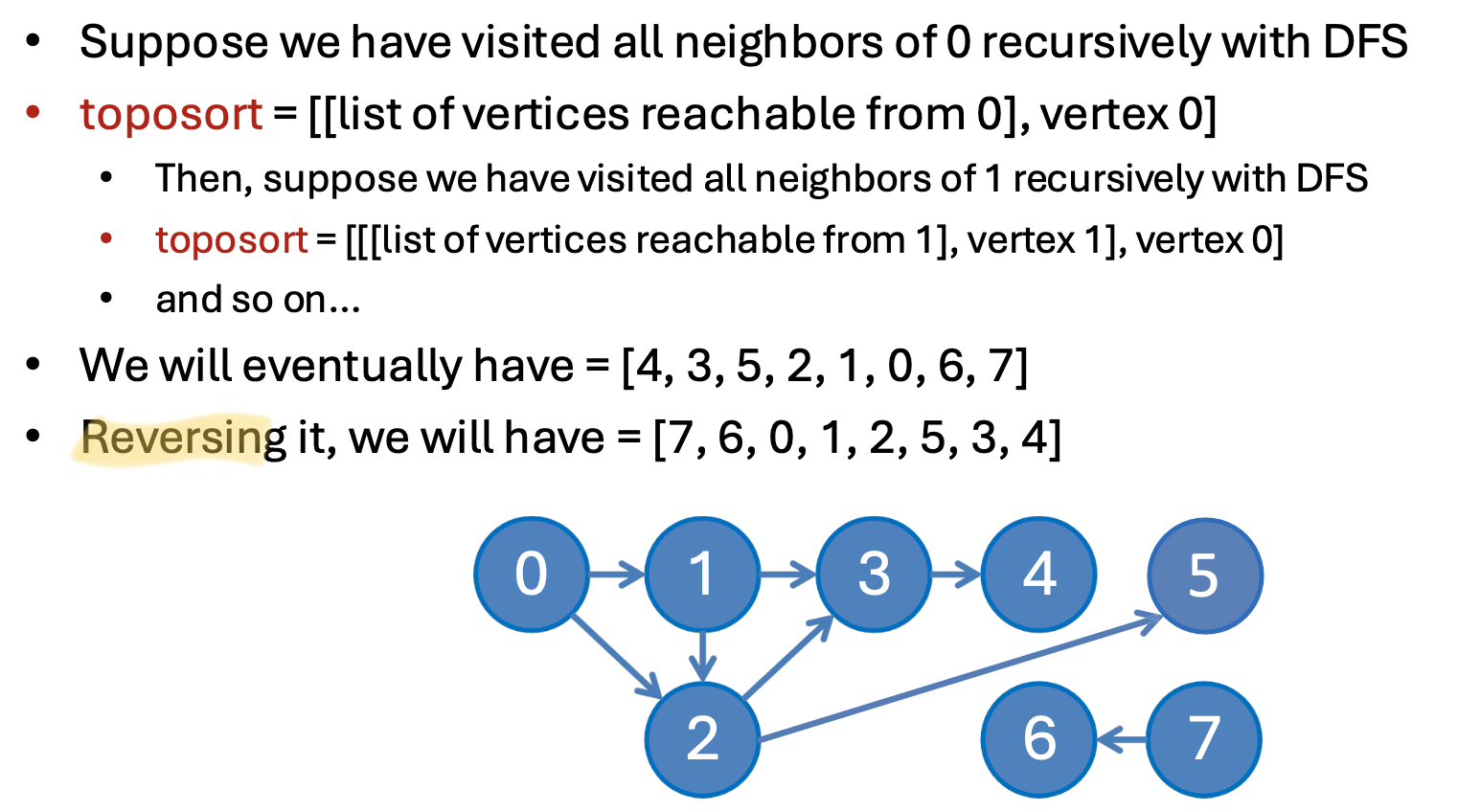
DFSrec(u) // **O(V+E)**
	visited[u] = 1 // to avoid cycle
	for all v adjacent to u // order of neighbour
		if visited[v] = 0 // influences DFS
			p[v] = u // visitation sequence
			DFSrec(v) // recursive (implicit stack)
	append u to the back of toposort // "post-order"

// in the main method
for all v in V
	visited[v] = 0
	p[v] = -1

for all v in V
	if visited[v] == 0
		DFSrec(v) // start the recursive call
**reverse toposort and output it**

// 1. normal DFS
// 2. once backtrack, append to toposort
// 3. reverse once done