class UnionFind { public int[] p; public int[] rank; public UnionFind(int N) { p = new int[N]; rank = new int[N]; for (int i = 0; i < N; i++) { p[i] = i; rank[i] = 0; } } // find the representative item of the set that contains item i // by recursively visiting p[i] until p[i] = i // compress the path to make future find operations O(1) public int findSet(int i) { if (p[i] == i) { return i; } else { p[i] = findSet(p[i]); return p[i]; } } public Boolean isSameSet(int i, int j) { return findSet(i) == findSet(j); } // if i and j belong to different disjoint sets // union them by setting representative item of the taller tree // to be the new rep of the combined set -> make result shorter public void unionSet(int i, int j) { if (!isSameSet(i, j)) { int x = findSet(i), y = findSet(j); // rank is used to keep the tree short if (rank[x] > rank[y]) { p[y] = x; } else { p[x] = y; if (rank[x] == rank[y]) { // rank increases rank[y] += 1; // only if both trees } // initially have same rank } } }}
collection of disjoint sets
Operations:
unionSet(i,j): Union two disjoint sets when needed
findSet(i): Find which set an item belongs to
isSameSet(i,j): Check if two items belong to the same set
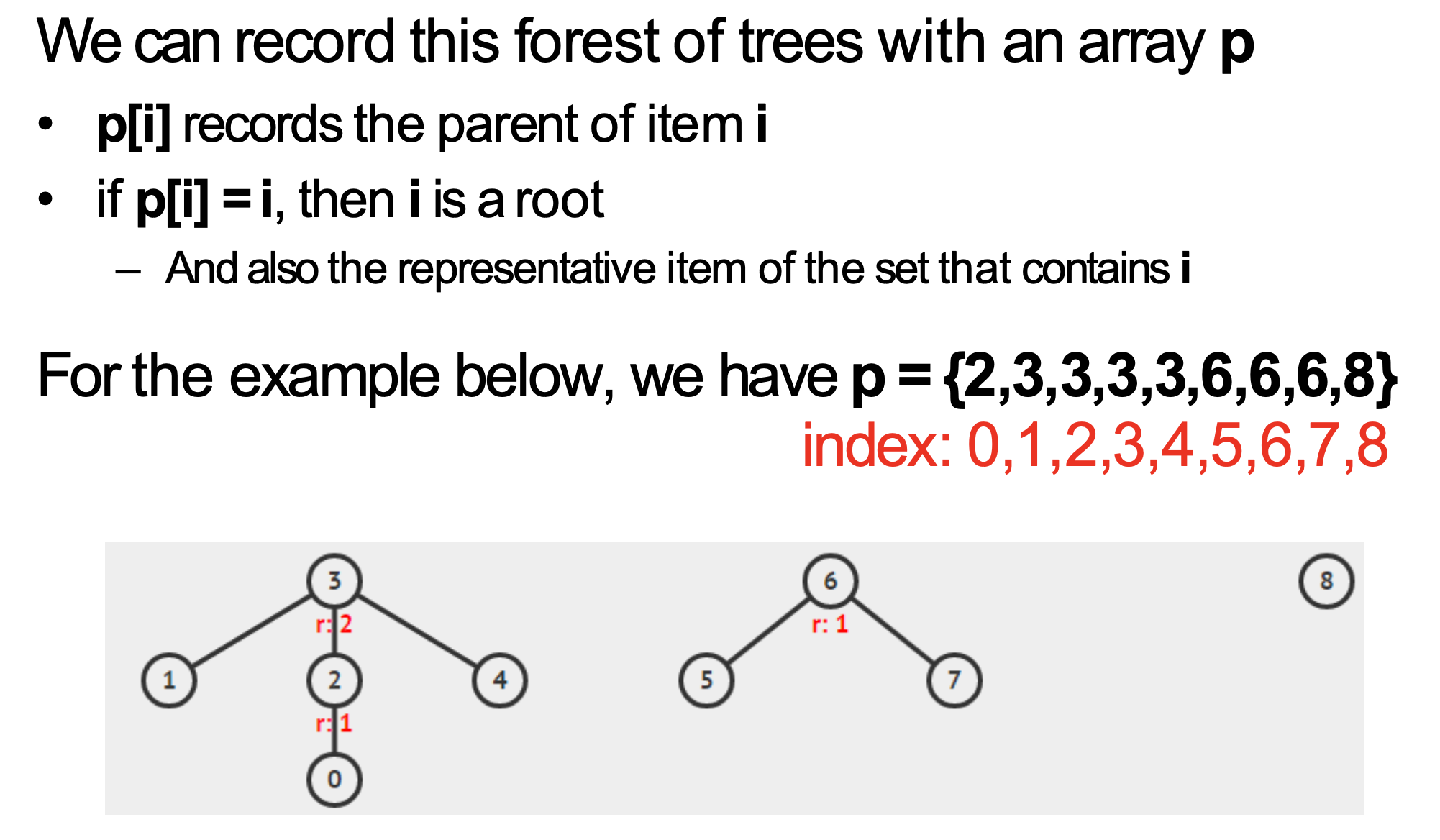
Each set is modelled as a tree - collection of disjoint sets forms a forest of trees
Each set represented by a representative item:root of the corresponding tree of that set
unionSet
Union-by-Rank
use another integer array rank, where rank[i] stores the upper bound of the height of (sub)tree rooted at i
this is just an upper bound as path compressions can make (sub)trees shorter than its upper bound
Summary
Used In
Kruskal’s Algorithm → L14 MST (detect whether adding an edge forms a cycle, by checking if two endpoints are in the same set)
Component counting in undirected graphs → L13 Graph Traversal (alternative to BFS/DFS-based component detection)