What is a Bond?:
- a bond is a fixed-income investment issued by governments or corporations to raise funding
- individuals lend money to a government or company at a specified interest rate for a predetermined period
- the entity repays individuals with interest in addition to the original face value of the bond
How Bonds Work?
- bonds are debt instruments - represent loans made to the issuer
- borrower issues a bond that includes the loan terms, interest payments that will be made, and the maturity date by which the bond principal must be repaid
- the interest payment is part of the return that bondholders earn for loaning money to the issuer
- the interest rate that determines the payment is the coupon rate
- initial price of most bonds is typically the par value, or the face value of a bond
- face value: what is paid to the lender upon maturity
Characteristics of Bonds:
| Face Value or Par Value | value of the bond at maturity and the reference amount the bond issuer uses when calculating interest payments |
|---|---|
| Coupon Rate | rate of interest the bond issuer will pay on the face value of the bond, expressed as a percentage |
| Coupon Dates | dates on which the bond issuer will make interest payments |
| Maturity Date | date on which the bond will mature and the bond issuer will pay the bondholder the face value of the bond |
| Issue Price | the price at which the bond issuer originally sells the bonds. in many cases, bonds are issued at par |
Bond Categories:
| Corporate Bonds | companies issue corporate bonds rather than seek bank loans for debt financing because bond markets offer more favorable terms and lower interest rates |
|---|---|
| Municipal Bonds | issued by states and municipalities. some municipal bonds offer tax-free coupon income |
| Government Bonds | • the US treasury issues several types of bonds. those with a year or less to maturity are bills, while notes have one to 10 years until maturity. |
| • government bonds issued with more than 10 years to maturity are called “bonds”. all bonds issued by the treasury are collectively referred to as “Treasuries” | |
| Agency Bonds | issued by government-affiliated organisations such as Fannie Mae or Freddie Mac |
Bond Prices and Interest Rates:
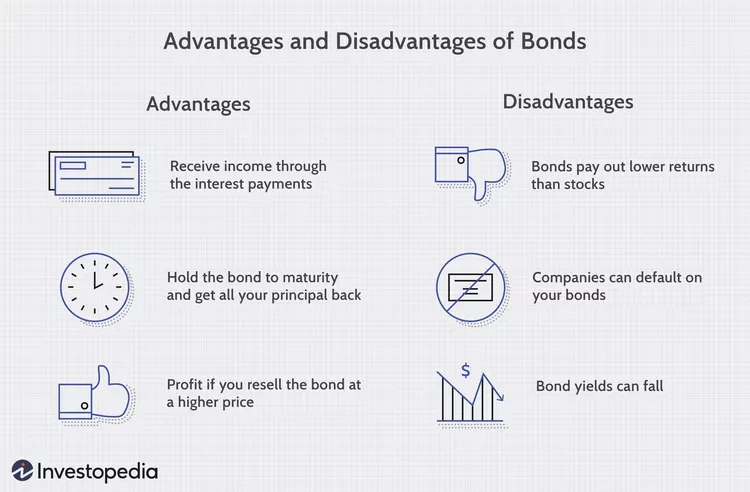
- if an investor holds a bond to maturity, they will get their principal back plus interest
- however a bondholder can sell their bonds in the open market, where the price can fluctuate
- bond’s price varies inversely with interest rates: when rates go up, bond prices fall to equalise the interest rate on the bond with prevailing rates, and vice versa
Yield-to-Maturity (YTM):

- the total return anticipated on a bond if it is held until the end of its lifetime
- considered a long-term bond yield but is expressed as an annual rate
- is the internal rate of return of an investment in a bond if the investor holds the bond until maturity and if all payments are made as scheduled
- evaluates the attractiveness of one bond relative to other bonds of different coupons and maturity in the market
💡💡💡
- investors can measure the anticipated changes in bond prices given a change in interest rates with the duration of a bond
- duration represents the price change in a bond given a 1% change in interest rates
- modified duration of a bond
- bonds with long maturities, as well as bonds with low coupons, have the greatest sensitivity to interest rate changes
Bond Variations:
| Zero-Coupon Bonds (Z-bonds) | • do not pay coupon payments and instead are issued at a discount to their par value that will generate a return once the bondholder is paid the full face value when the bond matures. • US treasury bills are zero-coupon bonds | | --- | --- | | Convertible Bonds | debit instruments with an embedded option that allows bondholders to convert their debt into stock (equity) at some point, depending on certain conditions like share price | | Callable Bonds | • have an embedded option, but it is different than what is found in a convertible bond • can be “called” back by the company before it matures • riskier for the bond buyer because the bond is more likely to be called when it is rising in value | | Puttable Bonds | • allows the bondholders to put or sell the bond back to the company before it was matured • valuable for investors who are worried that a bond may fall in value or if they think interest rates will rise, and they want to get their principal back before the bond falls in value • usually trades at a higher value than a bond without a put option but with the same credit rating, maturity and coupon rate because it is more valuable to bondholders |
What Determines a Bond’s Coupon Rate?
- credit quality and time to maturity are the principal determinants of a bond’s coupon rate.
- If the issuer has a poor credit rating, the risk of default is greater, and these bonds pay more interest.
- Bonds that have a very long maturity date also usually pay a higher interest rate.
- This higher compensation is because the bondholder is more exposed to interest rate and inflation risks for an extended period.
How Are Bond’s Rated?
- A company’s and its bonds’ credit ratings are generated by credit rating agencies like Standard and Poor’s, Moody’s, and Fitch Ratings.
- The highest quality bonds are called “investment grade” and include debt issued by the U.S. government and very stable companies, such as utilities.
- Bonds that are not considered investment grade but are not in default are called “high yield” or “junk” bonds.
- These bonds have a higher risk of default in the future, and investors demand a higher coupon payment to compensate them for that risk.6
What Is Duration?
- Bonds and bond portfolios will rise or fall in value as interest rates change. The sensitivity to changes in the interest rate environment is called “duration.”
- Duration describes how much a bond’s price will rise or fall with a change in interest rates.