L’imparfait
The imparfait describes the background to past events: what things were like, what was ongoing, or what happened habitually without a clear beginning or end.
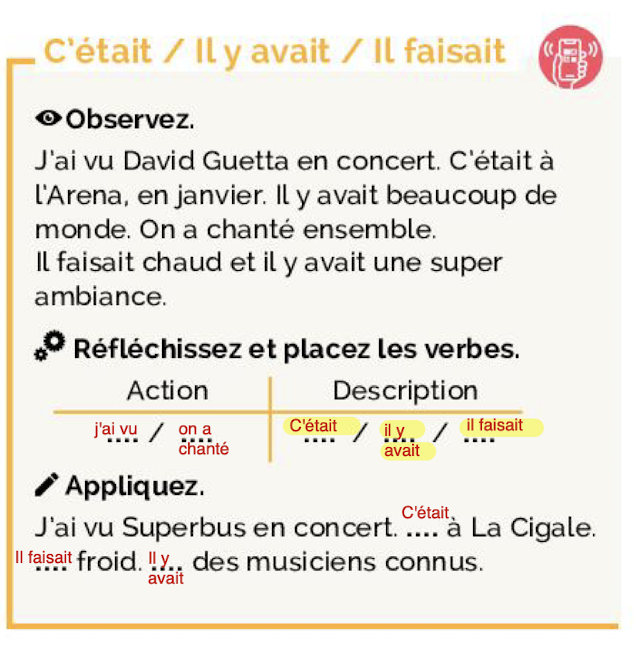
- Description: C’était génial.
- Ongoing background: Il y avait beaucoup de monde.
- Habit or repetition: something someone “used to” or “would” do.
Formation
For almost every verb:
- Take the nous form in the present tense.
- Remove -ons to obtain the stem.
- Add the imparfait ending.
| Pronoun | Ending |
|---|---|
| je | -ais |
| tu | -ais |
| il / elle / on | -ait |
| nous | -ions |
| vous | -iez |
| ils / elles | -aient |
Examples
- faire: nous faisons → fais- → je faisais, nous faisions
- manger: nous mangeons → mange- → je mangeais, nous mangions
- commencer: nous commençons → commenç- → je commençais, nous commencions
With manger, retain the e before a to keep the soft g sound (je mangeais), but remove it before i, where the sound is already soft (nous mangions).
With commencer, retain the cedilla before a to keep the soft c sound (je commençais), but remove it before i (nous commencions).
Note the pronunciation of faisions and faisiez: ai has an “e” sound.
L’imparfait d’être ⭐
Être is the only exception to the usual stem rule. Its imparfait stem is ét-, not somm-.
c'était = ce + était, the imparfait of être in the il/elle/on form. Thus, c'est in the present becomes c'était in the past.
| Pronoun | Présent | Imparfait |
|---|---|---|
| je | suis | étais |
| tu | es | étais |
| il / elle | est | était |
| nous | sommes | étions |
| vous | êtes | étiez |
| ils / elles | sont | étaient |
Décrire une ambiance
An atmosphere is normally a background state, so use the imparfait:
- C’était triste ≠ amusant.
- C’était passionnant ≠ ennuyeux.
- C’était génial ≠ nul.
For background description, c'était génial is normally the expected form. Ça a été génial is also grammatical, but it presents the experience as a completed whole.
Négation
The imparfait is a simple tense: it consists of one conjugated word and has no auxiliary. The negation therefore surrounds that verb:
subject + ne/n’ + verb in the imparfait + pas
| Présent | Imparfait |
|---|---|
| Je ne suis pas | Je **n’**étais pas |
| Il **n’**y a pas | Il **n’**y avait pas |
| On ne fait pas | On ne faisait pas |
nebecomesn'before a vowel or h muet: je n’étais pas, elle n’avait pas.- After negation, du / de la / des usually becomes de: Il n’y avait pas de monde.
- Other negative pairs work the same way: ne … jamais, ne … plus, ne … rien, ne … personne.
- Ce n’était jamais ennuyeux.
- Il n’y avait plus de places.
- In speech,
neis often omitted; retain it in formal writing.
Questions
The same three question structures used in the present also apply to the imparfait:
| Structure | Example |
|---|---|
| Intonation | C’était bien ? |
| Est-ce que | Est-ce que c’était bien ? |
| Inversion | Était-ce bien ? |
With question words:
- Comment c’était ? / Comment était l’ambiance ?
- Où est-ce que tu étais ? / Où étais-tu ?
- **Qu’est-ce qu’**il y avait ?
- Pourquoi est-ce qu’il faisait si chaud ?
- Combien de personnes est-ce qu’il y avait ?
Inversion does not need an extra euphonic -t- in the imparfait because the il/elle form already ends in -ait:
- Y avait-il beaucoup de monde ? — not y avait-t-il
- Faisait-il chaud ?
- Était-elle contente ?
Questions négatives
Negation and inversion combine as ne + verb-pronoun + pas:
- Tu **n’**étais pas là ?
- **N’**étais-tu pas là ?
Use si to contradict a negative question; use non to confirm the negative:
— Tu n’étais pas au concert ?
— Si, j’y étais !
Imparfait ou passé composé ? ⭐
| Passé composé | Imparfait | |
|---|---|---|
| Role | events that move the story forward | the backdrop around those events |
| Question | Qu’est-ce qui s’est passé ? | C’était comment ? |
| Time | completed and bounded | ongoing, with no clear beginning or end |
| Repetition | a completed number or period of repeated actions | an unbounded habit: “used to” or “would” |
| Typical use | actions | descriptions, weather, feelings, age, time and décor |
Think of a film: the imparfait is the set and lighting; the passé composé is what the actors do within it.
A common pattern combines an ongoing background action with a completed event:
Je dormais quand le téléphone a sonné.
The passé composé can also describe repeated actions when they are presented as a completed, bounded whole:
- J’ai visité Paris trois fois.
- Pendant une semaine, nous avons marché tous les jours.
Verbs that describe rather than act—especially être, avoir, il y a, and faire for weather—normally use the imparfait for background description: c’était, il y avait, il faisait.
Negation and inversion compared
| Passé composé | Imparfait | |
|---|---|---|
| Negation | Je n’ai pas vu—the negation surrounds the auxiliary | Je ne voyais pas—it surrounds the single verb |
| Inversion | As-tu vu ?—the auxiliary moves | Voyais-tu ?—the conjugated verb moves |