Le passé composé
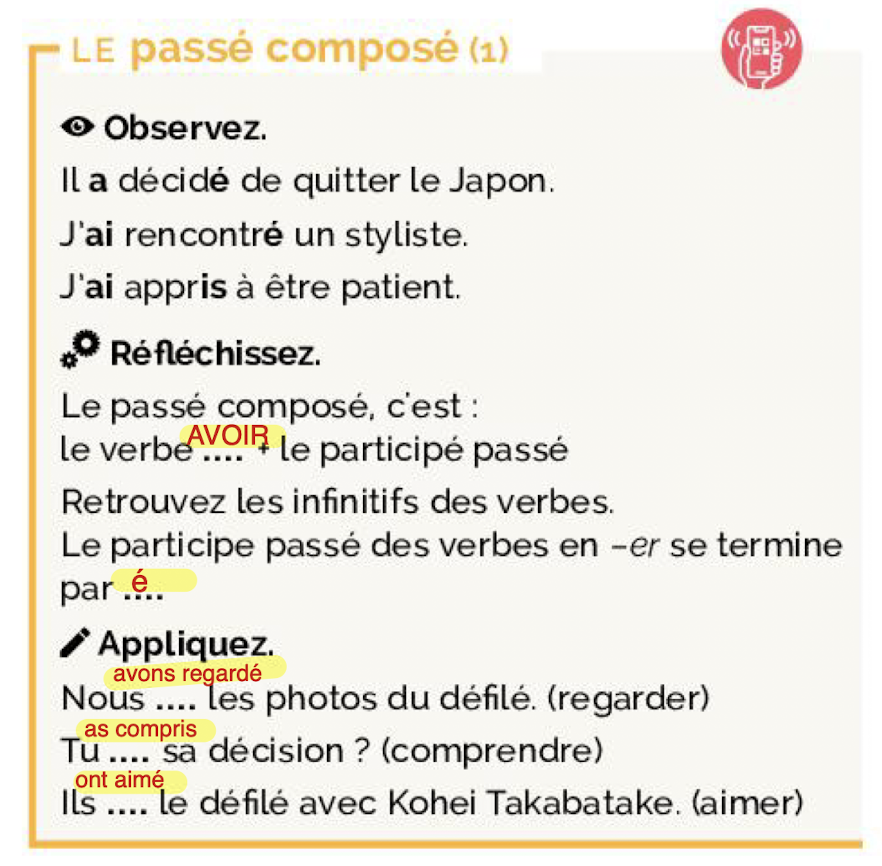
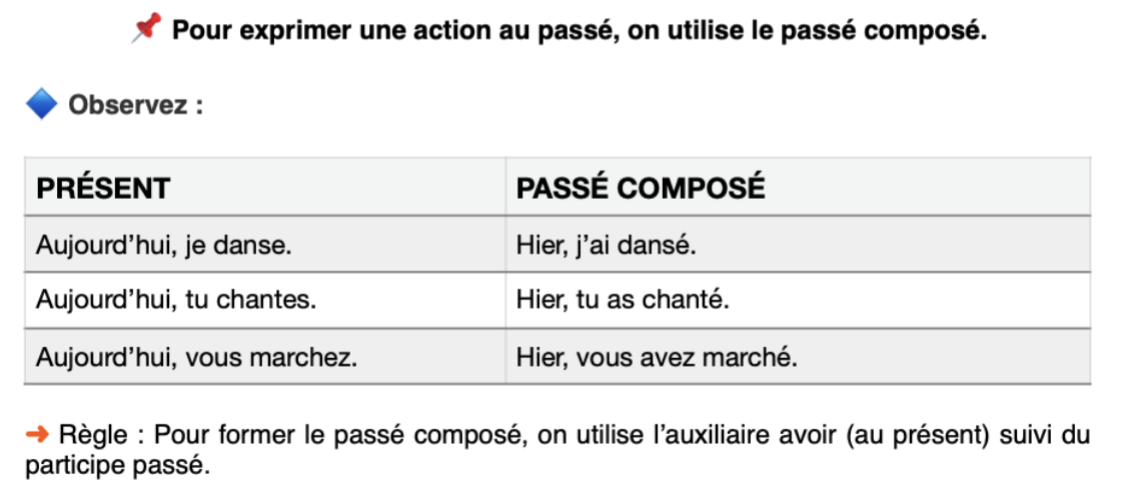
The passé composé describes completed actions or events viewed as a bounded whole in the past. It has two parts:
present-tense auxiliary (avoir or être) + participe passé
Avec avoir
Most verbs form the passé composé with avoir. Revise the present-tense conjugation at AVOIR.
| Subject | Auxiliary | Example with aimer |
|---|---|---|
| j’ | ai | j’ai aimé |
| tu | as | tu as aimé |
| il / elle / on | a | elle a aimé |
| nous | avons | nous avons aimé |
| vous | avez | vous avez aimé |
| ils / elles | ont | ils ont aimé |
Participes passés réguliers
| Infinitive group | Formation | Example |
|---|---|---|
| -er verbs | replace -er with -é | aimer → aimé |
| Regular -ir verbs | replace -ir with -i | finir → fini |
| -re verbs | often replace -re with -u | vendre → vendu |
Participes passés irréguliers
| Infinitive | Participe passé | Example |
|---|---|---|
| prendre | pris | j’ai pris |
| comprendre | compris | j’ai compris |
| apprendre | appris | j’ai appris |
| voir | vu | j’ai vu |
| lire | lu | j’ai lu |
| savoir | su | j’ai su |
| faire | fait | j’ai fait |
| être | été | j’ai été |
| avoir | eu | j’ai eu |
| boire | bu | j’ai bu |
| conduire | conduit | j’ai conduit |
| pouvoir | pu | j’ai pu |
| dormir | dormi | j’ai dormi |
Avec être
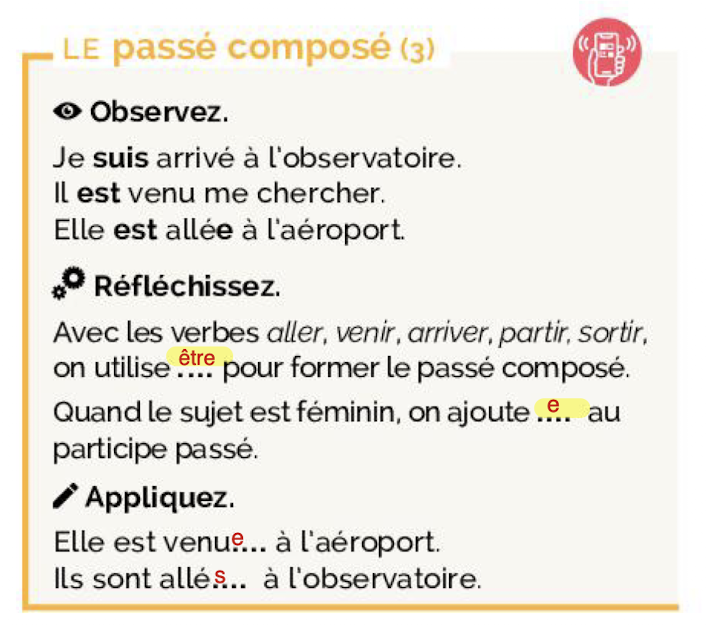
Some verbs, especially verbs of movement or change of state, or reflexive verbs (subject performs action on themselves), form the passé composé with être. The verbs introduced in TUT 1 and LEC 4 are:
| Infinitive | Participe passé |
|---|---|
| aller | allé |
| venir | venu |
| arriver | arrivé |
| partir | parti |
| monter | monté |
| descendre | descendu |
| entrer | entré |
| sortir | sorti |
| naître | né |
| mourir | mort |
| passer | passé |
| retourner | retourné |
| tomber | tombé |
| rester | resté |
| devenir | devenu |
| revenir | revenu |
| rentrer | rentré |
Reflexive verbs also form the passé composé with être:
- Je me suis habillé(e).
- Elle s’est levée tôt.
Verbs that can also take avoir
Some verbs in the list—especially monter, descendre, sortir, rentrer, retourner, and passer—use avoir when they take a direct object. Compare:
- Elle est sortie. — She went out.
- Elle a sorti son téléphone. — She took out her phone.
- Nous sommes montés. — We went upstairs.
- Nous avons monté les valises. — We took the suitcases upstairs.
Revise the present-tense conjugation at ÊTRE.
Accord du participe passé
With être, non-pronominal verbs agree with the subject in gender and number. Pronominal verbs require a separate agreement check: Elle s’est lavée, but Elle s’est lavé les mains (the direct object les mains follows the verb). See OQLF: agreement of pronominal verbs.
For aller:
| Subject | aller |
|---|---|
| je | suis allé(e) |
| tu | es allé(e) |
| il | est allé |
| elle | est allée |
| nous | sommes allé(e)s |
| vous | êtes allé(e)(s) |
| ils | sont allés |
| elles | sont allées |
Négation
The negation surrounds the auxiliary, not the participe passé:
subject + ne/n’ + auxiliary + pas + participe passé
- Je n’ai pas compris.
- Hier, je n’ai pas aimé le film.
- J’ai regardé le spectacle. → Je n’ai pas regardé le spectacle.
- J’ai aimé cette sculpture. → Je n’ai pas aimé cette sculpture.
- Je ne suis pas allé(e) à la fête hier.
- Il n’est pas monté dans la chambre.
- Hier, nous ne sommes pas sorti(e)s pour manger.
Interrogation
The question is formed around the auxiliary:
- Intonation: Tu as compris ? / Tu es arrivé(e) à l’heure ?
- Inversion: As-tu compris ? / Es-tu arrivé(e) à l’heure ?
- Est-ce que: Est-ce que tu as compris ? / Est-ce que tu es arrivé(e) à l’heure ?
Indicateurs de temps fréquents
- le mois dernier
- l’année dernière
- la semaine dernière
- l’été dernier / l’hiver dernier
- hier (soir) / avant-hier
- en 2018
Passé composé ou imparfait ?
The passé composé presents a completed, bounded event that moves a story forward; it does not necessarily happen only once. The imparfait describes its background, an ongoing state, or an unbounded habitual action. See Imparfait vs. passé composé and the original LEC 3 comparison.
- J’ai visité Paris trois fois. — several actions viewed as a completed whole
- Je dormais quand le téléphone a sonné. — ongoing background interrupted by a completed event
Supports de cours
From LEC 2: